Dumpster Rental for Roofing: Sizes, Weight and Costs
By Erik Rivera, Owner, Dumpsters.miami
Updated
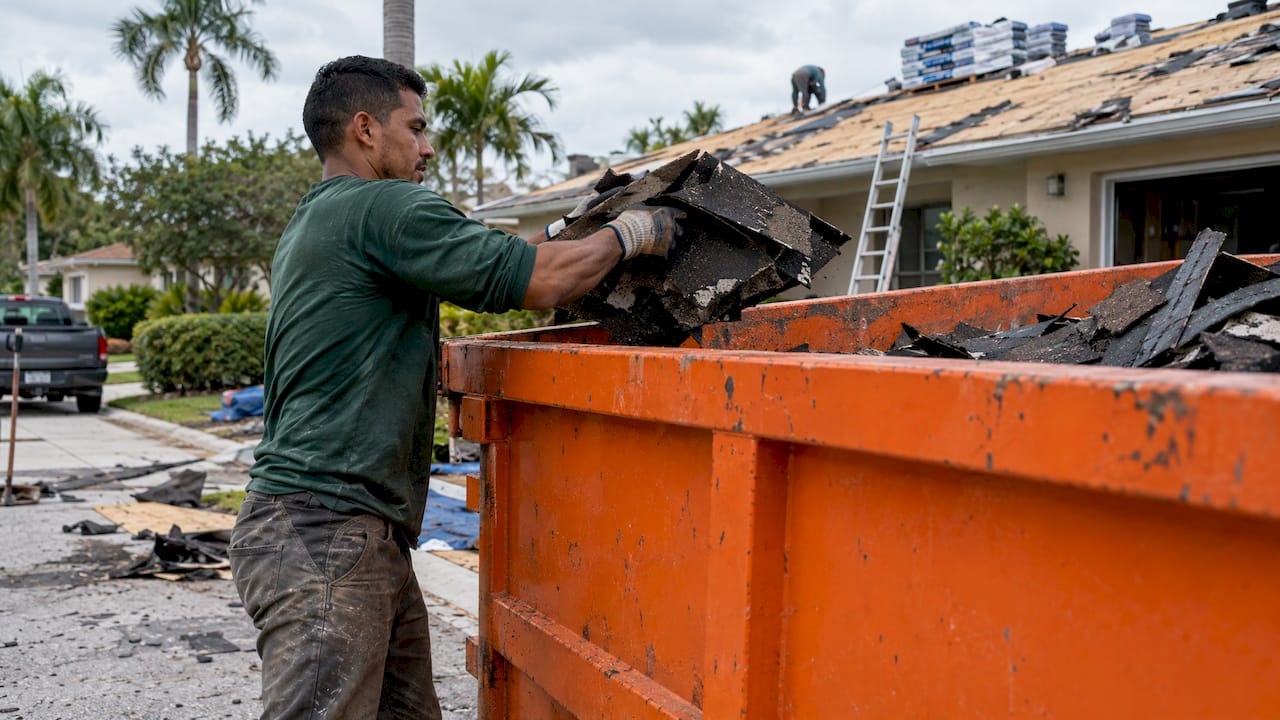
For most single-layer asphalt shingle roofs in Miami-Dade, a 20 or 30 yard roll-off dumpster holds the debris, but weight, not space, usually sets the final price: a typical 28-square shingle roof weighs about 4.2 tons, more than the 2 to 4 tons included with any of our sizes. Concrete tile roofs, common across Miami-Dade, weigh roughly three times as much per square and need a call to dispatch before you book. A 10 yard works for small roofs, patch jobs and single sheds. At Dumpsters.miami, every size is flat-rate, with delivery, pickup and a seven-day rental period included, so you can price the job before the first shingle comes off.
This guide walks through how to size the container, why weight matters more than volume on a roof, what can and cannot go in, and what to line up in Miami-Dade before delivery.
TL;DR
- Match the dumpster to your roof area and layer count. A second layer of shingles roughly doubles what you need to haul away.
- Roofing debris is heavy. A 28-square shingle roof is about 4.2 tons, so expect some weight overage at $85 per ton whichever size you pick. On that roof, the all-in cost runs $682 to $712 across our 20, 30 and 40 yard containers.
- Concrete tile weighs 880 to 970 pounds per square, about three times asphalt shingle. A tile tear-off may need more than one haul, so call dispatch first.
- Our flat rates are $395 for 10 yard, $495 for 20 yard, $595 for 30 yard and $695 for 40 yard, with delivery, pickup and seven days included.
- Keep roofing debris separate from trash and yard waste. Clean loads are easier to recycle, and some older materials need special handling.
- Placement matters in Miami-Dade. Check whether your dumpster will sit on the driveway or in the street before you book.
Table of Contents
- What a roofing dumpster is and when you need one
- How to pick the right size for your roof
- Why weight matters more than volume on a roof
- What can go in a roofing dumpster
- Recycling and disposal of roofing shingles
- Loading and placement
- Permits and local rules in Miami-Dade
- What a roofing dumpster costs with us
- Our perspective on roofing dumpsters
- Book a roofing dumpster for your Miami-Dade project
- FAQ
- Sources
What a roofing dumpster is and when you need one
A roofing dumpster is a standard roll-off container used for the debris of a tear-off: old shingles, underlayment, flashing, nails, rotted decking and packaging from the new materials. There is no special roofing model. What makes it a roofing rental is how you size it, where you place it and how you load it.
You need one in three situations:
- Full roof replacement. The whole roof comes off in a day or two, and the debris has to go somewhere right away. Piling it on the lawn or driveway slows the crew and creates a nail hazard.
- Partial replacement or large repair. After storm damage, a section of the roof or a single slope may come off. A 10 yard usually covers it.
- Roof plus other work. If you are also redoing soffits, fascia, a lanai cover or a shed roof, add that volume to the estimate.
Contractors typically order the container for their own jobs. If you are a homeowner hiring a roofer, ask whether the quote includes disposal. If it does not, or if you are managing the project yourself, you can rent the container directly through our residential dumpster rental service. Roofing contractors and property managers with multiple jobs can look at our construction dumpster rental page.
How to pick the right size for your roof
Roofers measure in squares. One square covers 100 square feet of roof. A typical single-family roof runs somewhere in the 20 to 35 square range, but the only number that counts is yours. Your roofer’s estimate or an aerial measurement report will state it.
IKO, a shingle manufacturer, explains that sizing depends on roof measurements, shingle type and weight, the dumpster’s weight limit and whether a second layer is present. Work through those four inputs in order.
Step 1: Measure the roof in squares
Take the total roof area in square feet and divide by 100. Include every slope, dormer and porch roof that is coming off. Roof pitch adds surface area, so use the actual surface measurement, not the footprint of the house. If your roofer gives the figure as “squares,” use it as is.
Step 2: Count the layers
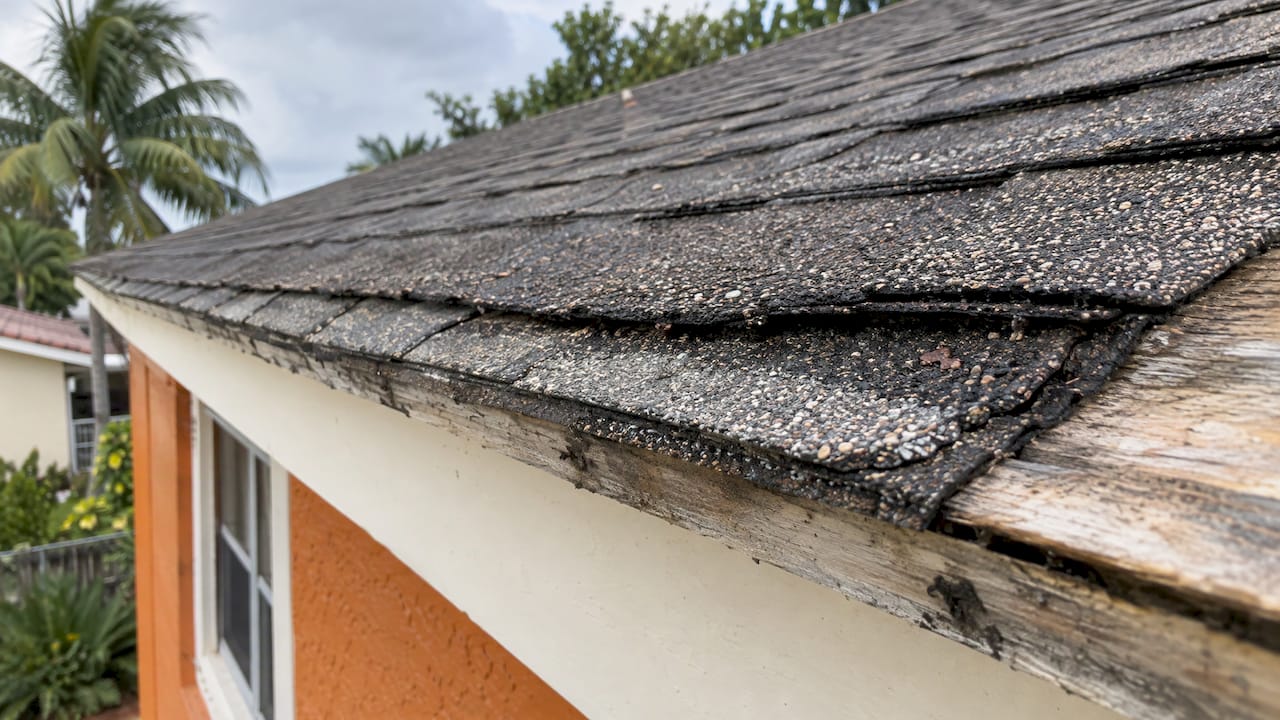
Older roofs sometimes carry a second layer of shingles installed over the first. The same IKO guide notes that a second layer doubles the dumpster size required and recommends checking beneath the top layer when you measure. A quick look at the roof edge, where the shingles end, often shows how many layers there are. If you are unsure, ask your roofer to confirm before you book.
Step 3: Know your shingle type
Three-tab shingles are lighter than architectural (dimensional) shingles. Tile, slate and metal behave differently again. Check the product name on the old roof or the invoice from the original install, and ask your roofer.
Concrete tile is the Miami-Dade case to plan for. Eagle Roofing, a major concrete tile maker, lists its standard profiles at 900 to 970 pounds per 100 square feet, with its Florida Capistrano tile at 880. That is roughly three times the 300 pounds per square used for shingles below. A 28-square tile roof is about 12.3 to 13.6 tons of tile alone, which is more than three times the 4 tons included with our largest container. A load that heavy has to be split, and heavy material rides best in a smaller container filled to a safe weight. For a tile tear-off, call dispatch with the roof size and tile type before booking, and we will plan the number of hauls with you.
Step 4: Match the size to the numbers
Use this table as a starting point. These are planning ranges for single-layer asphalt shingle tear-offs, not guarantees, and your contractor’s measurements should have the final say. The weight column is what the flat rate includes; anything over it is billed at $85 per ton from the disposal facility’s scale ticket.
| Dumpster | Our flat rate | Weight included | Typical fit for roofing |
|---|---|---|---|
| 10 yard | $395 | 1.5 tons | Small roofs, a single slope, a shed, garage or lanai roof, repair work |
| 20 yard | $495 | 2 tons | A typical single-layer shingle roof by volume; expect weight overage on anything over about 13 squares |
| 30 yard | $595 | 3 tons | Large homes, two layers on a smaller roof, tear-off with extra debris |
| 40 yard | $695 | 4 tons | Big residential roofs, multi-family and commercial flat or low-slope roofs |
If your roof sits between two sizes, think about which risk costs more. A container that is too small means a second delivery and a second rental. A container that is a size up costs the difference in the flat rate and gives the crew room to work. You can compare all four on our dumpster sizes and dimensions page.
Why weight matters more than volume on a roof
Most debris fills a dumpster by volume first. Roofing is the opposite: shingles are dense, and a container can reach its weight allowance before it looks full. That is why a roof tear-off is where weight overage shows up most often.
Our pricing page lists weight overage at $85 per ton, and extra rental days at $15 per day. Those are the two numbers worth understanding before you book.
A worked example
Here is a planning calculation you can repeat with your own figures. The numbers are an illustration, not a quote.
- Your roof measures 28 squares, one layer.
- Your roofer’s spec sheet says the shingles weigh about 300 pounds per square. (Look up the weight per square for your exact product; it varies by type.)
- 28 squares at 300 pounds is 8,400 pounds, or 4.2 tons, before decking, underlayment and nails.
- If a second layer is present, double the shingle portion: about 8.4 tons.
What that roof costs at each size
Here is the same 4.2-ton, single-layer roof priced at our published rates. It assumes the debris fits by volume, which dispatch confirms from your roof size before delivery.
| Dumpster | Flat rate | Overage ($85/ton) | Total |
|---|---|---|---|
| 20 yard | $495 | 2.2 tons = $187 | $682 |
| 30 yard | $595 | 1.2 tons = $102 | $697 |
| 40 yard | $695 | 0.2 tons = $17 | $712 |
The takeaway: on a heavy roof, the total barely changes with container size, because you pay for the tons either way. Pick the size on volume and room for the crew to work, not to dodge the weight fee. Overage is billed off the disposal facility’s scale ticket, which we share with you. If the same roof has a second layer (about 8.4 tons), the shingles alone are more than double the 4 tons included with our largest container. Ask dispatch whether to split the job into two hauls.
The second layer is what turns an ordinary job into a heavy one. This is also why we ask about layers when you call. The answer changes the size, and a clear answer up front avoids a surprise at the scale.
How to keep the weight in check
- Keep the load roofing-only. Mixing in concrete, tile or soil from other work adds weight fast.
- Order for the job you have. If a second layer is coming off, size up instead of hoping it fits.
- Tell dispatch what is going in. When you call, mention shingle type, layer count and any decking. We can then recommend a size against the real material.
What can go in a roofing dumpster
Ordinary roofing debris goes in without trouble:
- Asphalt shingles, 3-tab and architectural
- Felt and synthetic underlayment
- Metal flashing, drip edge and vents
- Old plywood or plank decking
- Roofing nails and packaging
Keep these out unless you have confirmed with dispatch: paint, solvents, roofing cement in liquid form, batteries, propane tanks and anything hazardous. Items like these need separate disposal. If you are not sure whether something qualifies, call before loading.
A note on asbestos in older roofs
Older roofing materials are the one safety point to take seriously. The Wisconsin Department of Natural Resources notes that asbestos may be present in flashing, fabrics, rolled roofing, mastic and pre-1973 shingles, and that grinding asbestos-containing material violates Clean Air Act restrictions. That is a federal law point, not a Wisconsin quirk.
In practice, if your home was built before the mid-1970s, or the roof includes old rolled roofing or mastic, ask your roofer whether the materials have been tested before demolition starts. If the roofer or an inspector suspects asbestos, stop and have the material tested by a licensed professional before it goes into any container.
Recycling and disposal of roofing shingles
Asphalt shingles are not just landfill. The Wisconsin DNR says they can be recycled into hot mix asphalt when sorted with minimal contamination, and encourages contractors to separate roofing waste at the job site. An EPA report on construction and demolition debris adds that the hot mix asphalt paving industry is the dominant market for non-asbestos asphalt shingles.
What that means for your job: a clean, roofing-only load is the best starting point for any recycling that is available. Whether a given load is recycled depends on the facility and the material, so we do not promise it. What you control is contamination:
- Keep trash, food waste and yard debris out of the roofing container.
- Pick up nails and loose fasteners from the yard with a magnet sweep after the tear-off.
- Do not mix new and old materials, such as leftover bundles, with a mixed-waste load if you can avoid it.
If you have trimmed trees as part of the roof work, put that in a separate container. Our yard waste dumpster guide explains how that works.
Loading and placement
A roof tear-off puts a lot of weight into the container in a short time. Load it with a plan.
- Spread the weight. Distributing heavy materials evenly helps prevent tipping or shifting during transport and reduces stress on the container.
- Stay under the fill line. Debris should not rise above the top edge of the walls. An overloaded container cannot be hauled safely.
- Park it close to the drop zone. The shorter the distance from roof edge to container, the less debris lands on the ground. Many crews use a chute or throw debris directly from the roof edge.
- Protect what is below. Put plywood under the container wheels’ footprint if the driveway is new or delicate.
- Sweep as you go. Nails in the grass or driveway are the most common cause of flat tires after a roof job. Plan a magnetic sweep at the end of each day.
In a Miami-Dade neighborhood, the usual decision is driveway versus street. A driveway is simplest. A container on the street or swale is where permit questions come up, and an HOA may also have its own rules. Many HOAs restrict how long a container can sit visible from the road, so check your rules before booking.
Permits and local rules in Miami-Dade
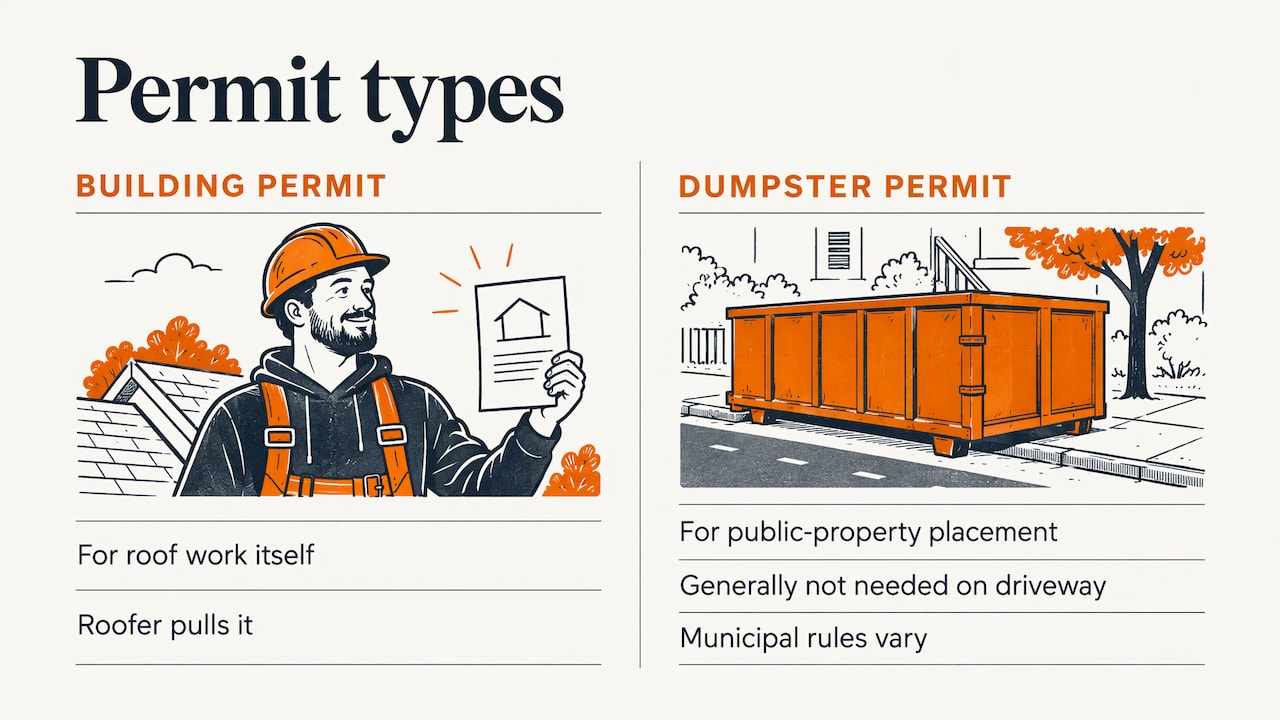
There are two different permits to keep apart. Your roofer pulls the building permit for the roof work itself. Miami-Dade and Broward are the Florida Building Code’s High-Velocity Hurricane Zone, with their own roofing rules and product approvals; the county’s roofing permit guide covers what your roofer files. A dumpster permit is separate, and applies when the container will sit on public property such as a street or right-of-way. A container on your own driveway generally does not need one, but rules vary by municipality within the county, and some cities have their own requirements.
Because we operate locally, we know how this plays out across Miami-Dade, and we handle permitting as needed for your project. Our Miami-Dade dumpster permit guide explains when a permit applies and where. For the roof permit and any disposal documentation your jurisdiction or insurer requires, ask your roofer and check with your city or county building department. Rules and fees change, so rely on the official office for current requirements.
Two practical points for storm season. After a hurricane or hard storm, demand for roofers and containers both spike. Booking early in the week and confirming a delivery window helps, and our same-day dumpster rental covers most orders placed by noon when a schedule shifts at the last minute. Right after a storm, same-day slots fill fastest, so book as early as you can.
What a roofing dumpster costs with us
Our prices are flat, and published for every size. Each rental includes delivery, pickup and a seven-day rental period.
| Item | Price |
|---|---|
| 10 yard dumpster | $395 |
| 20 yard dumpster | $495 |
| 30 yard dumpster | $595 |
| 40 yard dumpster | $695 |
| Extra rental day | $15 per day |
| Weight overage | $85 per ton |
Seven days is more than enough for most residential roof replacements, since the tear-off itself is usually one to two days. The extra-day fee is there if weather or material delays push the schedule. In Miami, afternoon storms are a fact of life, and a roofer may lose a day or two. Build that into your estimate.
You can see the whole structure on our pricing page, and service areas such as Doral, Kendall and Homestead have the same flat rate with no hidden fees.
Our perspective on roofing dumpsters
The numbers above lead to a simple rule. On an asphalt shingle roof, choose the size on volume and let the weight fee fall where it falls: across our 20, 30 and 40 yard containers, a 4.2-ton roof costs within $30 either way. If your roof is close to the line on volume, take the larger container, because a second haul costs more in time than the step up in price.
Tile is the exception. A concrete tile roof can outweigh any single container, so don’t book a size off a chart; call with the roof size and tile type, and plan the hauls first.
Book the container when you book the roofer, not the day before the tear-off. Delivery, pickup and a seven-day rental are included, and same-day delivery is available on most orders placed by noon.
Book a roofing dumpster for your Miami-Dade project
If your roof date is set, the next step is simple: pick the size, tell us the address and we will confirm delivery. Our flat-rate roll-offs start at $395 for a 10 yard and go up to $695 for a 40 yard, with delivery, pickup and seven days included.

For homeowners, start with our residential dumpster rental. For contractors and commercial roofs, the construction dumpster rental page covers larger and repeat jobs. To get a container delivered the same day, see our same-day dumpster rental page, or visit Dumpsters.miami to get started.
FAQ
What size dumpster do I need for a roof replacement?
For a typical single-layer shingle roof, a 20 yard is the usual starting point by volume, and a 30 yard suits larger roofs. Expect some weight overage on a full roof, and call before booking for a second layer or a tile roof, which can need more than one haul. Small roofs, sheds and repairs fit a 10 yard. Measure the roof in squares, confirm the layers with your roofer and call dispatch with those numbers for a recommendation.
How do I dispose of old roofing shingles?
Put them in a roll-off dumpster and keep the load roofing-only. Clean loads of asphalt shingles are the ones that can be recycled into hot mix asphalt, according to the Wisconsin DNR. Do not dump shingles on vacant lots, swales or curbs, which can bring code citations.
Does a second layer of shingles change the dumpster size?
Yes. A second layer roughly doubles the amount of material, so the size you need goes up with it. IKO’s sizing guide says to check for a second layer beneath the first when you measure. Tell us the count when you book so we size for the weight and the volume.
What happens if my roofing debris is too heavy?
Weight overage is billed at $85 per ton, as listed on our pricing page. On a full shingle roof some overage is normal: a 28-square roof weighs about 4.2 tons against the 2 to 4 tons included, so the total lands between $682 and $712 whichever size you pick. Keep non-roofing debris out so you only pay for roofing tons, and call dispatch before a tile tear-off, which can need more than one haul.
Do I need a permit for a roofing dumpster in Miami-Dade?
It depends on placement. A container on your own driveway usually does not require a dumpster permit, while one on a street or public right-of-way can. We handle permitting as needed, and our permit guide explains the details. Your roofer handles the separate building permit for the roof itself.
Sources
- Proper Dumpster Size for Roofing Shingles Disposal, IKO
- Recycling Residential Asphalt Shingles in Wisconsin, Wisconsin DNR
- State of the Practice of Construction and Demolition Debris, US EPA
- Dumpster Loading Safety Tips, HIWASTE MFG
Recommended
Need a dumpster in Miami-Dade?
Flat-rate pricing with delivery, pickup and 7 days included. Same-day delivery on most orders placed by noon.